
Small and medium-sized businesses face constant pressure to grow faster, operate more efficiently, reduce costs, and keep up with increasing customer expectations. But most companies rely on a scattered combination of tools: Excel sheets, standalone accounting software, manual HR files, a separate inventory system, and paper-based workflows.
This fragmentation creates silos, errors, duplicate data entry, and a lack of real-time visibility ultimately holding companies back.
This is where an All-in-One Business System becomes a game-changer.
1. What Is an All-in-One Business System?
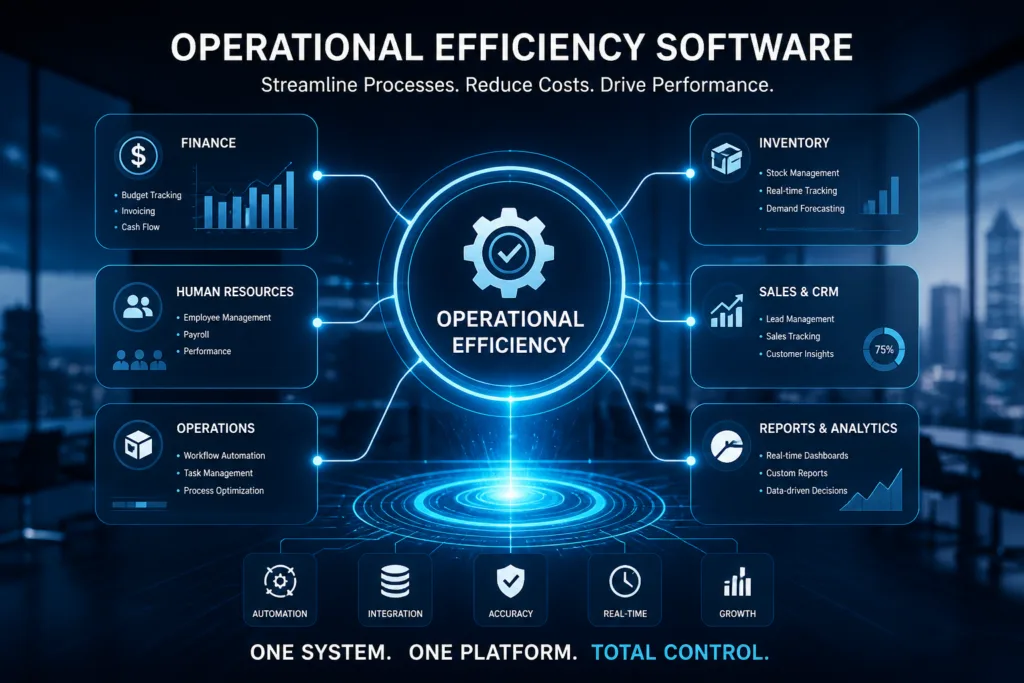
An all-in-one business system is a unified software platform that brings together the essential functions of a business into one integrated environment, such as:
Accounting & Finance
Sales & Invoicing
Inventory & Stock Control
Human Resources & Payroll
Purchasing & Suppliers
Operations & Workflows
Reporting & Analytics
Instead of using 6–10 separate tools, companies operate through one centralized system, ensuring that every department works with the same accurate, real-time data.
2. Why Companies Need an All-in-One Business System
A) Eliminates Data Duplication and Errors
When sales, accounting, and inventory are separate, the same data is entered multiple times.
This leads to:
inconsistent figures
delays
miscalculations
wrong decisions
A unified system automatically syncs all departments, reducing human error dramatically.
B) Real-Time Visibility Across the Entire Company
Managers can instantly access:
P&L
cash flow
stock levels
sales performance
HR records
supplier balances
This level of clarity is impossible with scattered systems.
C) Faster Operations and Higher Productivity
Unified systems automate:
invoicing
stock updates
financial posting
attendance and payroll
approval workflows
reporting
Employees spend less time on manual tasks and more time on growth.
D) Better Decision Making
With all data flowing through the same system:
KPIs
dashboards
profitability analysis
cost breakdowns
customer behavior patterns
…become accessible in seconds.
Leaders can see the business as one complete picture.
E) Reduced IT Costs
Instead of paying separately for:
accounting software
HR software
inventory system
POS
CRM
…an all-in-one solution consolidates everything.
Lower cost. Better accuracy. Less maintenance.
F) Stronger Data Security
Data is stored in one secure environment rather than scattered across devices, folders, emails, and spreadsheets.
This reduces:
data loss
unauthorized access
corruption of files
breaches
outdated backups
3. How an All-in-One Business System Works
The system uses a single database with modules that communicate seamlessly:
A sales invoice updates inventory, accounting, and customer balance instantly.
An attendance record updates payroll calculations automatically.
A purchase order updates supplier data, stock, and cost analysis in real time.
Every action flows across departments without the user having to re-enter anything.
4. The Competitive Advantage of Using All-in-One Systems
Companies that adopt unified systems experience:
✔ 40–60% faster daily operations
✔ 80–90% reduction in manual errors
✔ 20–35% improvement in profitability visibility
✔ Better team collaboration
✔ Higher scalability
✔ Faster onboarding of employees
Modern business demands integration, not fragmentation.
5. Connection to Mozon Systems (Soft, Non-Promotional Integration)
Platforms like Mozon’s integrated business systems apply this exact concept by offering:
Accounting & Finance
Sales & Operations
Inventory Management
HR & Payroll
Purchasing & Suppliers
Reporting & Analytics
Branch, user, and permission control
Cloud support and real-time access
All working within one unified ecosystem tailored specifically for SMEs in the region.
This gives small and medium businesses the power of enterprise-level technology at an accessible scale and cost.
6. Who Benefits the Most?
Retail and trading businesses
Service companies
Clinics and small healthcare providers
Industrial and manufacturing workshops
Online stores
Educational institutions
Startups aiming to scale
Any business that wants to reduce chaos, increase clarity, and grow sustainably benefits from unifying its systems.
Conclusion
An All-in-One Business System is no longer a luxury it is the backbone of modern business success.
It eliminates manual work, integrates departments, delivers real-time insights, and empowers companies to grow faster with fewer resources.
Businesses that move away from fragmented tools and switch to unified platforms will always outperform those stuck in outdated systems.