Introduction
For decades, enterprises relied on large, monolithic systems to manage their operations. These systems promised stability and control, but over time they revealed a serious limitation: inflexibility.
As markets accelerate, regulations evolve, and business models diversify, enterprises are realizing that success no longer depends on having the biggest system but on having the most adaptable architecture.
This shift has given rise to a new paradigm in enterprise software design: Composable Enterprise Systems.
Rather than forcing organizations to operate within rigid structures, composable systems allow enterprises to design software around how they actually work today and tomorrow.
What Are Composable Enterprise Systems?
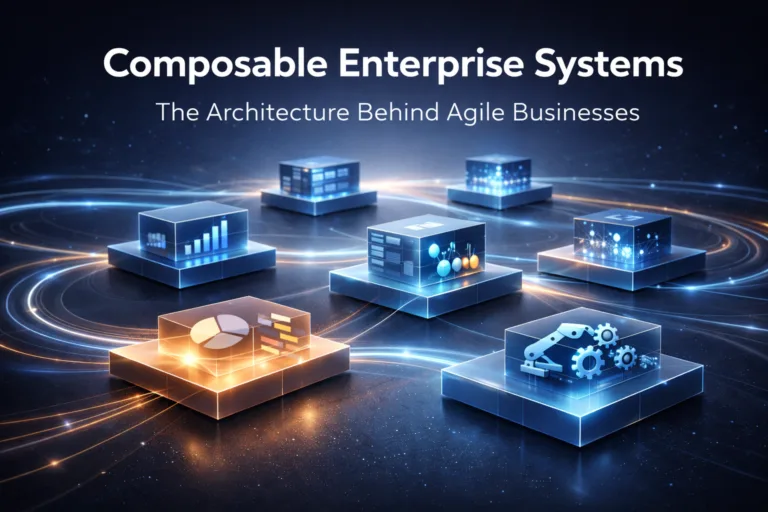
Composable Enterprise Systems are built on the principle of modularity. Instead of one tightly coupled platform, the enterprise system is composed of independent, interchangeable components that work together through standardized integrations.
Each component:
Serves a specific business capability
Can be deployed, upgraded, or replaced independently
Integrates through APIs or shared data layers
Evolves without disrupting the entire ecosystem
In simple terms, composable systems let enterprises assemble their digital operations like building blocks, not concrete structures.
Why Traditional Enterprise Systems Are Reaching Their Limits
Traditional enterprise platforms were designed for predictability. Modern enterprises, however, operate in environments defined by change.
Common challenges with legacy systems include:
Slow response to regulatory or market changes
High dependency between unrelated business functions
Costly upgrades that affect the entire system
Limited ability to adopt new technologies incrementally
These constraints turn software into a bottleneck rather than an enabler.
Composable systems address these issues at the architectural level — not through customization, but through design.
The Core Principles of Composable Enterprise Systems
1. Modular Business Capabilities
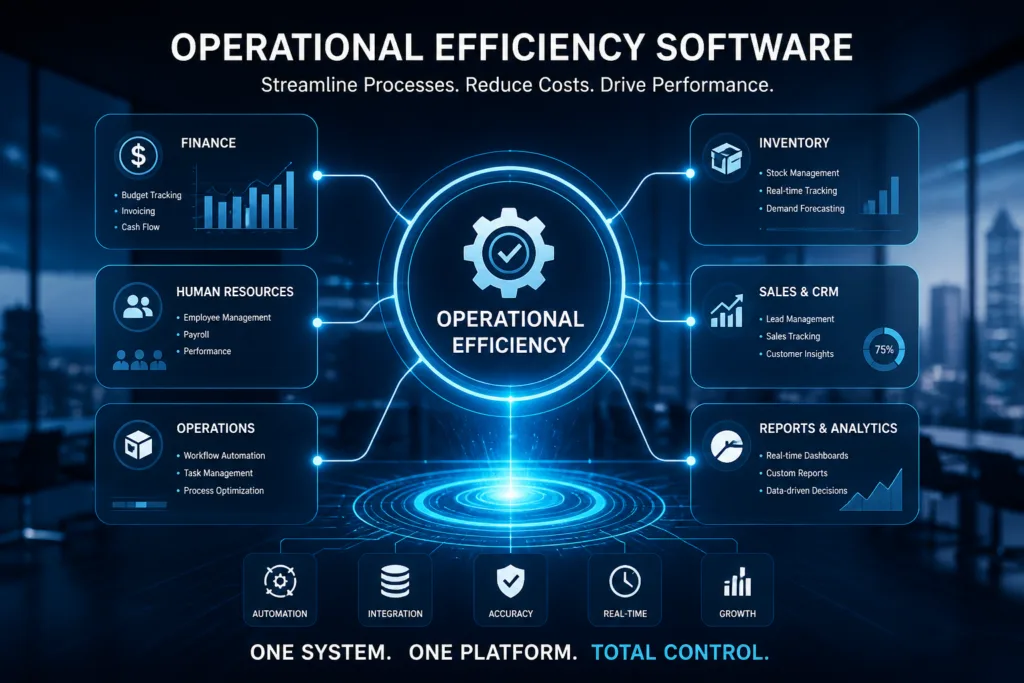
Each business capability — finance, HR, operations, compliance, analytics — exists as a self-contained module.
This allows enterprises to:
Deploy only what they need
Expand capabilities gradually
Avoid unnecessary complexity
2. Loose Coupling, Strong Integration
Composable systems are loosely coupled but tightly integrated.
This means:
Modules communicate through clear contracts
Failures are isolated, not systemic
Innovation in one area does not destabilize others
3. Continuous Evolution
Instead of waiting for major system upgrades, enterprises can evolve continuously by:
Enhancing specific modules
Adopting new capabilities without replatforming
Retiring outdated components safely
This turns digital transformation into an ongoing process rather than a disruptive project.
Business Benefits of Composable Enterprise Systems
Greater Organizational Agility
Enterprises can respond faster to:
Market shifts
Regulatory changes
New operational requirements
Software becomes a strategic asset, not a limitation.
Lower Long-Term Risk
By avoiding single-system dependency, organizations reduce:
Upgrade risks
Vendor lock-in
Operational downtime
Each change is smaller, safer, and more controlled.
Better Alignment Between Business and IT
Composable systems allow IT teams to support business strategy directly by:
Enabling faster experimentation
Supporting parallel initiatives
Scaling specific capabilities independently
Composable Systems vs Monolithic Enterprise Platforms
| Aspect | Monolithic Systems | Composable Systems |
|---|---|---|
| Architecture | Tightly coupled | Modular |
| Scalability | System-wide | Capability-based |
| Change Impact | High risk | Isolated |
| Innovation Speed | Slow | Fast |
| Long-Term Flexibility | Limited | High |
Who Should Consider Composable Enterprise Systems?
Composable architecture is especially valuable for:
Growing enterprises with evolving needs
Multi-entity or multi-region organizations
Businesses undergoing digital transformation
Enterprises facing frequent regulatory change
Organizations planning long-term scalability
It is not about replacing everything overnight it is about designing for adaptability.
The Strategic Shift: From Systems to Capabilities
Composable Enterprise Systems represent a deeper shift in thinking.
Instead of asking:
“What system do we need?”
Enterprises now ask:
“What capabilities do we need — and how do we evolve them?”
This mindset aligns technology with strategy and ensures that software grows with the business, not ahead of it or behind it.
Conclusion
Composable Enterprise Systems are not a trend they are an architectural response to modern enterprise reality.
In a world defined by complexity and change, the most resilient organizations are those that build systems designed to adapt, scale, and evolve continuously.
The future of enterprise software is not bigger platforms
it is smarter composition.