
In today’s business landscape, success is no longer determined solely by product quality or sales volume. It depends on an organization’s ability to measure performance accurately, analyze results intelligently, and make data-driven strategic decisions.
This is where Enterprise Performance Management (EPM) becomes the backbone of modern management.
What Is Enterprise Performance Management?
Enterprise Performance Management (EPM) is an integrated managerial framework designed to:
Align strategic objectives with operational performance
Measure results using clear Key Performance Indicators (KPIs)
Analyze gaps between planned and actual outcomes
Continuously improve efficiency and profitability
In simple terms:
EPM transforms vision into numbers and numbers into decisions.
Why Enterprise Performance Management Is No Longer Optional
Modern markets are:
Highly competitive
Rapidly evolving
Increasingly complex
Organizations without a structured performance management system often experience:
Misaligned decision-making
Weak financial control
Declining profitability
Poor visibility into operational risks
In contrast, companies that implement effective EPM systems achieve:
Sustainable growth
Strong financial discipline
Strategic clarity
Faster, smarter decision-making
Core Components of Enterprise Performance Management
1. Strategic Planning
Translating vision into measurable and actionable objectives.
2. Budgeting and Forecasting
Aligning financial planning with operational strategy.
3. Key Performance Indicators (KPIs)
Tracking financial, operational, and sales performance.
4. Analytics and Reporting
Leveraging interactive dashboards and intelligent reporting tools.
5. Continuous Improvement
Refining processes based on measurable insights and performance data.
Performance Management vs. Results Management
Results management focuses on what happened.
Enterprise performance management goes further by asking:
Why did it happen?
What is likely to happen next?
What should we change?
This requires integrated systems, predictive analytics, and unified data sources.
The Role of Technology in Enterprise Performance Management
Effective EPM cannot rely solely on spreadsheets.
Modern digital systems provide:
Real-time dashboards
Department-level profitability analysis
Actual vs. target performance tracking
Trend forecasting
Intelligent financial reporting
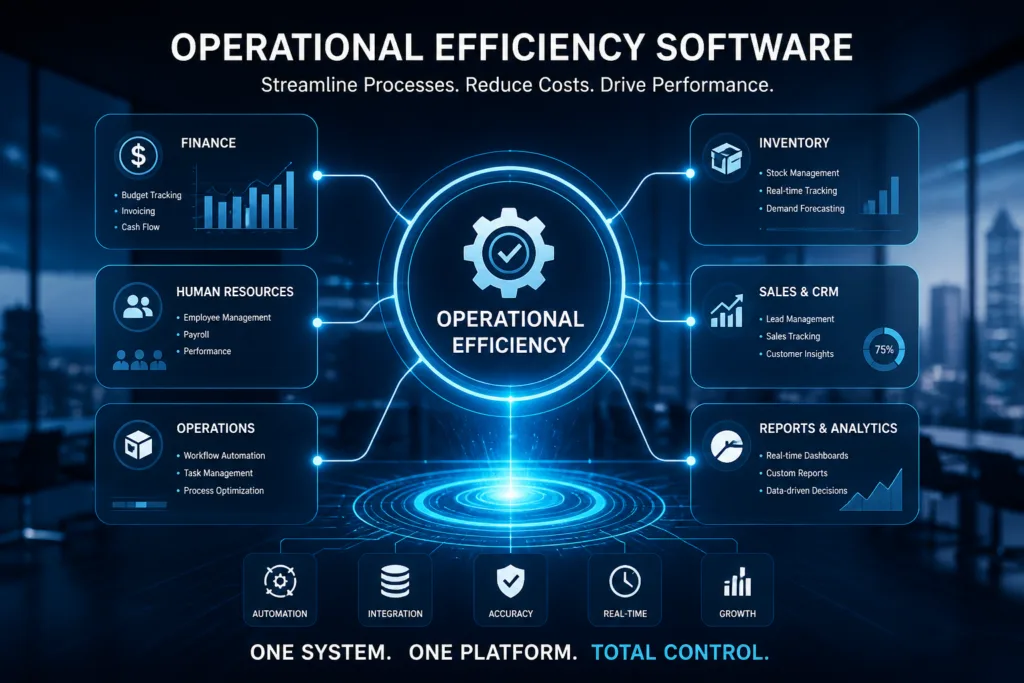
Advanced ERP systems play a central role in EPM because they integrate:
Accounting
Sales
Inventory
Human Resources
Operations
Into one unified data platform.
Key Enterprise Performance Indicators
Financial KPIs
Profit margin
Return on Investment (ROI)
Cash flow
Expense-to-revenue ratio
Operational KPIs
Inventory turnover
Order fulfillment time
Production efficiency
Managerial KPIs
Customer growth rate
Customer satisfaction
Employee productivity
How to Build an Effective Enterprise Performance Management System
Step 1: Define Clear Strategic Objectives
You cannot measure performance without a defined destination.
Step 2: Establish Measurable KPIs
KPIs must be:
Specific
Measurable
Achievable
Strategically aligned
Step 3: Unify Data Sources
All departments must operate within a single, integrated system.
Step 4: Develop Dashboards and Reporting Tools
Reports should be:
Real-time
Visual
Easy to interpret
Step 5: Conduct Regular Performance Reviews
Monthly or quarterly reviews ensure alignment and adaptability.
Common Mistakes in Enterprise Performance Management
Using too many KPIs without strategic focus
Relying on inaccurate or fragmented data
Failing to link performance to incentives
Ignoring predictive analytics
Operating across disconnected systems
The Future of Enterprise Performance Management
Emerging trends shaping the future include:
Predictive analytics
AI-driven decision support
Real-time interactive dashboards
Automated reporting
Fully cloud-based systems
Organizations investing in these capabilities gain a clear competitive advantage.
The Relationship Between ERP and Enterprise Performance Management
An ERP system is more than an accounting tool. It serves as:
A centralized data hub
A financial analysis engine
An operational control platform
A strategic reporting system
When implemented effectively, ERP transforms enterprise performance management from manual monitoring into automated strategic intelligence.
Organizations adopting integrated business management systems such as those available at\
are able to convert daily operational data into strategic, data-driven decisions.
Conclusion
Enterprise Performance Management is no longer a theoretical concept. It is:
A competitive necessity
A cost-control mechanism
A growth accelerator
A strategic decision-making framework
Companies that manage performance intelligently manage their future confidently.