
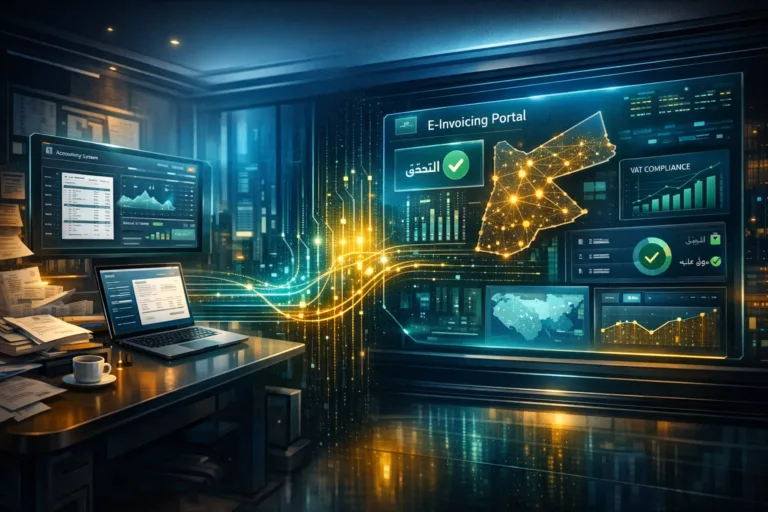
Integrating Your Accounting System with National E-Invoicing: How to Move from Traditional Financial Management to Smart Compliance
An accounting system is no longer just a tool for recording entries and generating reports. Today, it has become a core connection point between businesses and regulatory authorities. As national e-invoicing expands, integrating the accounting system with the national invoicing platform has become an operational, legal, and strategic necessity at the same time.
What will you learn in this article?
What does integrating an accounting system with national e-invoicing actually mean?
Integration means enabling your company’s accounting system to create invoices electronically, validate their data, send them to the national e-invoicing platform, receive acceptance, rejection, or verification statuses, and store all of that within the same financial record.
In other words, the invoice no longer remains just an isolated internal document. It becomes part of a unified financial flow that starts from the sale or service, passes through accounting, tax, archiving, and reporting, and ends with clear compliance that can be reviewed at any time.
When this cycle is fully integrated, the company becomes faster in execution, more accurate in its data, and more prepared for audit requirements and regulatory obligations.
Why has integration become a real necessity for businesses?
Because the market has changed. In the past, businesses could manage invoices through separate accounting software, spreadsheets, or disconnected workflows. Today, however, the challenge is no longer only internal. It is also external: how can you ensure that your financial data is aligned with official requirements, accurate, fast, and fully traceable?
Regulatory Compliance
National e-invoicing requires businesses to operate with a higher level of accuracy and commitment, which makes manual handling far riskier than ever before.
Operational Speed
Integration shortens the time between invoice creation, submission, and follow-up, while reducing delays caused by entering the same data multiple times.
Data Clarity
When invoices are directly connected to accounting, tax, and reporting, management gains a clearer and more reliable financial picture.
How does the integration process work operationally and technically?
The technical details vary from one platform to another, but the general structure is usually similar. What matters most is having an accounting system that can interact with national e-invoicing requirements instead of merely storing invoices locally.
Organizational Setup and Core Data Preparation
The process starts with preparing the company’s data correctly: tax number, company information, branches, tax settings, and properly structured customer, item, and service records. Any weakness at this stage will later affect invoice acceptance or rejection.
Setting Up Integration Credentials and Connectivity
After registering on the national platform and issuing the integration credentials, the connection data is entered into the accounting system and linked to the invoicing module so that sending and tracking become part of the daily workflow.
Building the Invoice in the Required Structure
The system collects invoice data from its source: customer, items, taxes, discounts, totals, and required references. The invoice is then constructed in the format required by the official platform instead of leaving the user to handle that manually.
Validation Before Submission
The best systems do not just send invoices. They perform pre-validation of key fields and logical structure in order to reduce the likelihood of rejection and the delays and corrections that follow.
Submission and Status Response
Once submitted, the platform returns a response: Was the invoice accepted? Does it need correction? Was it officially validated? This response must immediately reflect inside the accounting system so the user can see the status in the same record or screen.
Archiving, Traceability, and Reporting
The real value is only complete when the integration result is stored with the invoice itself and linked to reporting and accounting. This is the point at which integration becomes not just a technical connection, but a truly smart financial system.
The main challenges companies face during integration
Many companies assume that integration is just a quick technical task, only to discover that the real problem is not the connection itself. The real challenge often lies in data readiness, system flexibility, and the stability of internal processes.
Legacy Systems That Were Never Built for Integration
Some accounting systems were designed only to manage entries and reports, not to connect with national platforms and electronic invoice workflows.
Poor Data Quality
Unstructured names, missing tax numbers, poorly organized item records, or inaccurate tax settings all make integration much more difficult.
Lack of Exception Management
Rejected invoices, failed submissions, and retry scenarios all require a system that can handle non-ideal cases professionally and consistently.
The biggest mistake companies make
Treating national e-invoicing as an external add-on disconnected from the financial cycle. That may work temporarily, but it usually creates duplicated effort, more mistakes, and weaker control over financial data.
The operational and financial benefits of integration
Integrating your accounting system with national e-invoicing does not only provide compliance. It also creates direct advantages for internal performance and decision-making.
- Reduced duplicate data entry: the invoice is created once and used across multiple financial paths.
- Lower human error: the fewer manual steps involved, the more reliable the final outcome becomes.
- Faster processing and follow-up: seeing invoice status immediately reduces delays and uncertainty.
- Easier auditing and review: a clear record of invoices and responses makes internal and external audits much easier.
- More accurate management reporting: data becomes connected across sales, tax, accounting, and collections.
- Better scalability: as the company grows, a connected system can absorb more volume without operational breakdown.
The difference between an integrated company and a non-integrated one
| Factor | Non-Integrated Company | Integrated Company |
|---|---|---|
| Invoice Creation | Often manual or split across disconnected steps | Created inside the financial system as part of one unified workflow |
| Data Quality | More exposed to repetition, inconsistency, and omissions | More consistent because the source is unified and processes are connected |
| Status Tracking | Requires separate monitoring and manual checking | Status appears directly in records, screens, and reports |
| Compliance | More vulnerable to delay, rejection, or operational disruption | Greater ability to comply and reduce risk |
| Scalability | Any growth creates more pressure on staff and processes | The system absorbs growth more efficiently and more sustainably |
Why do you need an accounting system that is ready from the ground up?
Because successful integration cannot be built on top of chaos. You can always try to attach an external solution to an outdated system, but in that case you are usually treating symptoms rather than the root issue. When the system itself is designed to manage accounting entries, reports, tax requirements, integration, and archiving within a unified structure, then integration becomes a natural extension of the system rather than an extra burden.
A system that is ready from the start gives you:
- A structured data model that supports reliable integration.
- A clear workflow from invoice to entry to report.
- Greater scalability and easier configuration as requirements evolve.
- More flexible management of branches, currencies, taxes, and approvals.
- Less dependence on temporary manual workarounds.
How does Mozon Financial Management System support this integration?
When we talk about integration with national e-invoicing, the requirement is not just an attractive invoicing screen. What companies really need is a complete financial system that knows how to manage accounting entries, statutory reports, archiving, budgets, currencies, and integration with other modules.
This is where Mozon Financial Management System (MACC) stands out as an advanced financial platform that helps businesses manage accounting and financial operations with greater accuracy and flexibility, while supporting financial and legal reporting, budgeting, cost centers, fixed assets, financial forecasting, and integration with other systems within a broader ERP environment.
Invoices Connected to the Financial Flow
Instead of separating invoices from accounting, MACC connects the entire financial process from documentation to reporting.
Better Organization and Archiving
Invoices and supporting documents remain connected to financial records, making review, audit, and regulatory response much easier.
Higher Integration Readiness
When the system is built to integrate with other modules and compliance workflows, the journey toward national e-invoicing becomes smoother and more stable.
Why does this matter in practice?
Because a company does not just need to “send an invoice.” It needs a system that links invoices to accounting, tax reporting, cost centers, cash flow, and financial analysis. That is the real difference between a partial tool and a true financial platform.
A simplified practical scenario inside the company
Imagine a sales employee issues an invoice to a customer. In a disconnected environment, the invoice may be created in one place, then submitted manually elsewhere, and later the accountant may need to re-enter or reconcile the same information again. In a properly prepared accounting system, however, the invoice moves through one connected process:
- The invoice is created inside the system.
- Taxes and reference data are applied automatically according to the system settings.
- The key fields are validated before submission.
- The invoice is submitted to the national e-invoicing platform.
- The status response is received and linked to the financial record.
- The effect appears in reports, archiving, and follow-up without duplicated effort.
This scenario does not only improve efficiency. It also improves the quality of management decisions because leadership sees the full financial picture rather than isolated fragments of it.
Frequently Asked Questions
Does integration with national e-invoicing mean replacing the accounting system entirely?
Not always. However, if the current system is not prepared for integration, modifying it can become more complex and expensive than adopting a more flexible and ready solution.
What is the biggest reason integration projects fail?
Poorly structured data and treating e-invoicing integration as an external layer disconnected from the core financial cycle inside the company.
Is the value of integration only about compliance?
No. The value also extends to automation, lower error rates, faster follow-up, better reporting, and stronger readiness for growth and expansion.
When should a company start integrating with national e-invoicing?
The earlier, the better. Delaying integration usually increases the cost of adaptation and prolongs dependence on manual procedures and temporary workarounds.
Make national e-invoicing part of your financial ecosystem, not an extra burden on it
If your business is looking for a system that helps manage accounting operations with accuracy, organize invoices and supporting documents, and improve compliance and financial reporting, then Mozon Financial Management System (MACC) is a smart step toward a more integrated and stable financial environment.