AI Winter: When the Future Freezes and Digital Promises Collapse
Could artificial intelligence enter another period of slowdown despite today’s remarkable progress? In this article, we explore the meaning of AI Winter, its causes, its history, and the lessons it offers to businesses and technology leaders.
Every time artificial intelligence reaches a new peak of global attention, an essential question emerges: are we witnessing a sustainable technological revolution, or are we repeating a historical cycle that may end in a cold period of retreat known as AI Winter?
What is AI Winter?
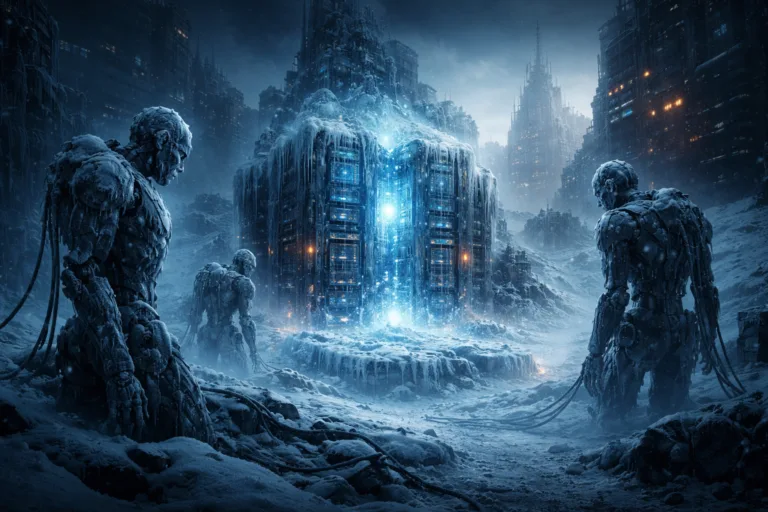
The term AI Winter refers to historical periods in which the field of artificial intelligence experienced a sharp decline in funding, public interest, and expectations after waves of excessive hype.
These periods do not necessarily mean that AI has failed forever. Rather, they signal a serious decline in confidence, reduced financial support, and a contraction in the number of projects and innovations, especially when actual results fall far short of the excitement that came before them.
Why Does AI Winter Happen?
1. Overhyped Expectations
In every major technology wave, excitement grows quickly and large promises begin to dominate the conversation.
- “AI will solve every problem”
- “Robots will fully replace humans”
But reality is often more complicated. Technology needs time, and it always faces technical, operational, and commercial limitations.
2. Weak Practical Results
At certain stages, AI systems may be:
- Slow
- Inaccurate
- Difficult to commercialize
When promises do not translate into tangible results, confidence can decline very quickly.
3. Lack of Data or Computing Power
Before the era of big data and cloud infrastructure, data was limited and computing was expensive and slow. As a result, many AI ideas were simply not practical at scale.
4. Funding Follows Results
When there are no real profits or clearly successful applications, funding drops rapidly, and companies and research labs begin shutting down or scaling back their AI initiatives.
The Core Insight
AI Winter does not happen because the idea of artificial intelligence is weak. It happens because the technology is sometimes marketed as being far more capable than it actually is at that moment.
Major AI Winter Periods in History
The First AI Winter in the 1970s
After the early enthusiasm of the 1960s, the available systems of that time failed to produce results that matched expectations. Algorithms were limited, computing power was weak, and several governments and research institutions reduced their support.
The Second AI Winter in the Late 1980s and Early 1990s
This period was closely tied to the failure of expert systems to deliver on the promises surrounding them. While they initially appeared highly promising, their limitations became obvious over time.
- Difficult maintenance
- High costs
- Limited adaptability
- Results that did not justify the investment
What Has Changed Today?
Today, we are living in a very different environment from the one that defined earlier AI winters. This is why the current moment cannot be compared to the past in a simplistic way.
1. Big Data
We now have access to enormous volumes of data that allow models to be trained more effectively, improving both performance and accuracy.
2. Cloud Computing
Cloud infrastructure provides powerful computing resources at lower cost, making innovation faster, more scalable, and more accessible.
3. Deep Learning
Deep learning created a major leap in image recognition, natural language processing, speech systems, and other advanced prediction tasks.
4. Real Applications
AI is no longer just a concept. It now powers chatbots, recommendation engines, intelligent analytics, automation tools, and many everyday digital experiences.
Can AI Winter Happen Again?
Yes, it absolutely can. Technology history may not repeat itself in the exact same form, but it often repeats the same patterns in new ways.
1. Another Wave of Hype Inflation
If the market continues promoting the idea that AI can solve everything instantly, and real outcomes fail to match that promise, disappointment could trigger another sharp decline in confidence.
2. Extremely Strict Regulations
Laws that heavily restrict data access or severely limit the use of AI could slow development and reduce the pace of adoption.
3. A Global Economic Downturn
During economic crises, investment often shifts away from high-risk innovation and toward essential, short-term returns.
4. Market Saturation with Weak Tools
When thousands of AI tools appear without delivering meaningful value, the market becomes noisy and crowded, making it harder to distinguish real innovation from empty packaging.
The Difference Between AI Bubble and AI Winter
| Concept | Meaning |
|---|---|
| AI Bubble | An inflated wave of expectations, investment, and promises |
| AI Winter | A decline or collapse that follows when those expectations are not fulfilled |
What Do We Learn from AI Winter?
1. Do Not Trust Hype Alone
Not everything said about artificial intelligence is accurate or realistic. Hype creates attention, but only value creates sustainability.
2. Real Value Is the Foundation
Successful AI is AI that:
- Solves a real problem
- Saves time
- Reduces cost
- Improves decision quality
3. Sustainability Matters More Than Speed
The companies that survive difficult periods are not necessarily the loudest. They are the most disciplined in building practical, useful, and durable solutions.
How Can Companies Benefit Today Without Falling Into the Winter?
1. Focus on Real Use Cases
- Accounting automation
- Financial data analysis
- Decision support
- Intelligent customer service
2. Do Not Use AI Just Because It Is Trendy
The most important question before launching any AI initiative is simple: does this solve a real problem?
3. Start Small and Then Scale
Begin with a prototype, test it carefully, measure results, and only then expand based on evidence rather than excitement.
4. Tie AI to Business Value
AI without clear commercial or operational impact can quickly become a burden rather than a competitive advantage.
The Future of AI: Peak or Beginning?
The truth is that we are living through one of the strongest phases in the history of artificial intelligence, but this is not the end of the journey. The most realistic scenario is not a total collapse, but a series of corrections in which weaker projects disappear while stronger, value-driven solutions remain.
The Most Likely Scenario
- A slowdown in some areas rather than a total collapse
- Weak projects leaving the market
- Strong, useful solutions continuing to grow
- Greater maturity in how AI is applied in business
Frequently Asked Questions
What is AI Winter?
It is a period in which interest and investment in artificial intelligence decline because real-world results fall short of high expectations.
Is AI in danger right now?
Not in the traditional sense, but some parts of the market could slow down if hype continues to outpace meaningful results.
Why did AI fail before?
Earlier AI waves struggled because of weak technology, limited data, high cost, and expectations that were unrealistic for the tools available at the time.
Can AI Winter happen again?
Yes. If the same mistakes return—overhyped expectations, lack of real value, and a market filled with weak tools—another AI Winter is possible.
Conclusion
AI Winter is not total failure.
It is a natural correction that follows inflated expectations.
The real winner is always the one who builds real value, not temporary noise.