Introduction: A New Era of Digital Education
Education is undergoing a profound transformation across the globe. Schools, training centers, and universities are facing increasing pressure to modernize their operations, deliver personalized learning experiences, and manage large volumes of academic and administrative data.
As institutions evolve, a critical question arises:
How can educational organizations operate efficiently without juggling dozens of separate systems?
The answer lies in adopting an all-in-one education management platform a unified digital ecosystem that brings academic, financial, administrative, and communication processes together under one intelligent hub.
What Is an All-in-One Education Management Platform?
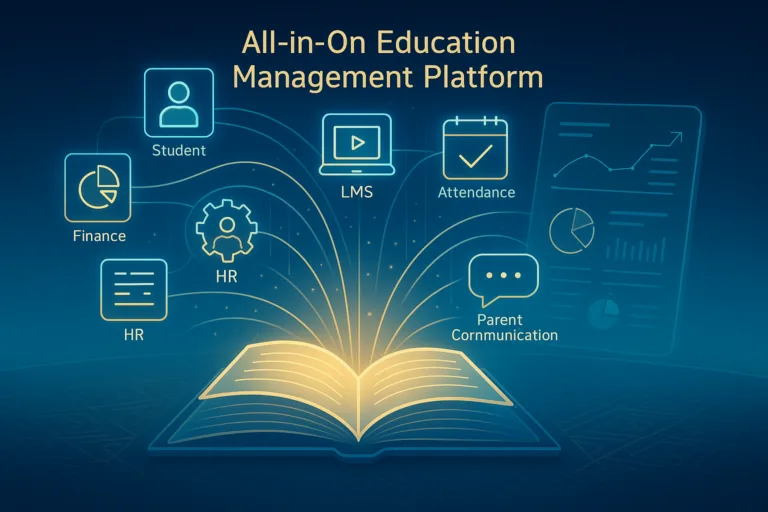
An all-in-one education management platform is a comprehensive software solution designed to manage every aspect of an institution’s operations, including:
Student Information Systems (SIS)
Attendance and behavior tracking
Learning management and digital content
Finance, billing, and payment management
HR and staff administration
Communication with parents and students
Transportation and schedule planning
Reporting and analytics
Instead of relying on multiple scattered tools, the platform centralizes all workflows, offering institutions a seamless and efficient way to operate.
Why Institutions Need an All-in-One Education Management Platform
1. Centralized Data and Unified Workflows
Schools often use separate systems for admissions, payments, academic records, and communication. This fragmentation leads to errors, delays, and inefficiencies.
A unified platform ensures:
One database for all departments
Real-time updates across the institution
Consistency and accuracy of student records
2. Improved Learning Experience
Modern education requires flexibility. Students and parents expect:
Online assignments and digital resources
Real-time grades and feedback
Easy communication with teachers
An all-in-one platform streamlines these interactions and enhances student engagement.
3. Automation of Administrative Processes
Manual processes drain time and resources. Automated workflows can handle:
Admissions and enrollment
Fee invoicing and collection
Timetable generation
Certificate issuance
HR and payroll operations
This reduces human error and frees staff for strategic tasks.
4. Enhanced Communication
Effective communication is vital for student success.
All-in-one platforms offer integrated channels like:
Mobile apps
Parent portals
Notifications and announcements
Messaging between teachers, students, and parents
Clear communication builds trust and strengthens the educational environment.
Core Components of a Modern All-in-One Platform
1. Student Information System (SIS)
The core database storing demographic data, academic history, attendance, evaluations, disciplinary actions, and more.
2. Learning Management System (LMS)
A digital classroom offering:
Assignments
E-learning modules
Teacher feedback
Content sharing
3. Finance and Billing
Automated tuition invoicing, fee tracking, receipts, and integration with accounting systems.
4. Human Resources & Staff Management
Managing teacher information, schedules, leave balances, payroll, and performance.
5. Analytics and Dashboards
Data-driven insights help administrators evaluate:
Academic performance
Attendance patterns
Revenue and expenses
Resource utilization
6. Mobile Access
Mobile apps ensure that parents, students, and teachers remain connected anytime, anywhere.
Benefits for Schools and Educational Institutions
1. Efficiency Across All Departments
A unified system reduces redundancy and data entry errors.
2. Better Decision Making
The availability of real-time data improves planning and forecasting.
3. Higher Parent Engagement
Parents receive transparent and timely updates on their children’s progress.
4. Cost Reduction
Institutions avoid paying for multiple apps and software subscriptions.
5. Scalability
Whether managing 100 students or 10,000, an all-in-one platform scales easily with growth.
Why All-In-One Platforms Outperform Traditional Tools
Traditional Systems
Fragmented
Difficult to integrate
Limited reporting
High maintenance costs
All-In-One Platforms
Unified
Integratable with external APIs
Offer rich analytics
Lower operating costs over time
The Future of Education Management
As expectations rise for digital transformation in the education sector, all-in-one platforms will continue to evolve. Upcoming features include:
AI-powered personalized learning pathways
Predictive analytics for student performance
Smart attendance tracking using biometrics
Automated curriculum mapping
Integrated e-payment ecosystems
The institutions that embrace these technologies will lead the future of education.
Conclusion
An all-in-one education management platform represents much more than a digital tool—it is the foundation for modern, efficient, data-driven educational environments.
By consolidating academic, financial, administrative, and communication processes into one unified system, institutions can deliver superior learning experiences, improve operational excellence, and ensure long-term growth.
For schools seeking reliability, scalability, and true digital transformation, adopting an all-in-one platform is no longer a luxury it is a necessity.