
Introduction: What is a Cash Van System and Why Do Companies Need It?
Thousands of distribution-based companies across sectors such as food and beverage, dairy, FMCG, household goods, pharmaceuticals, snacks, water, and consumer products rely on mobile sales representatives to deliver products and collect payments directly from customers.
Traditional challenges such as:
Manual paperwork errors
Inaccurate inventory
Delayed cash collection
Limited visibility and tracking
Inconsistent pricing
Weak operational control
have pushed companies toward adopting Cash Van Systems as a comprehensive digital solution for managing field sales and distribution.
In simple terms:
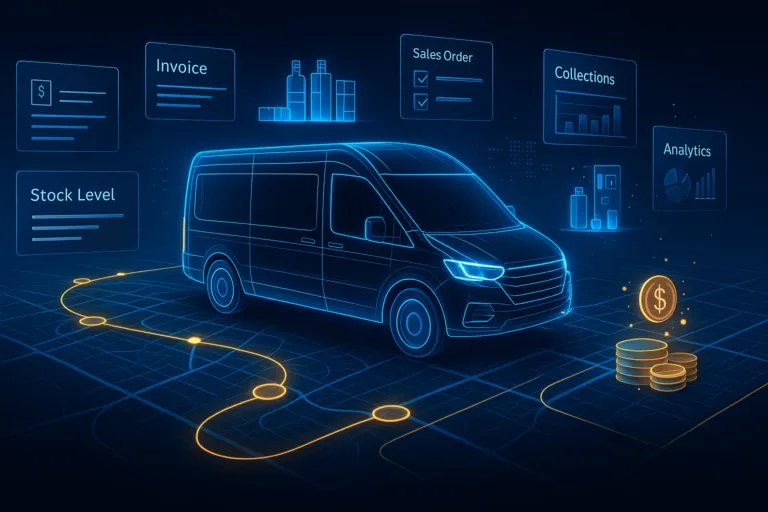
A Cash Van System is an integrated digital platform that enables field sales representatives to manage sales, distribution, collection, and inventory directly from their van, with real-time synchronization to the central system.
Chapter 1: Core Components of a Cash Van System
1. Mobile Application for Field Sales Representatives
This is the primary tool used by the salesperson. Typically runs on rugged Android devices.
Key Features:
Display products, pricing, promotions
Van inventory management
Issuing invoices (Cash / Credit)
Cash and cheque collection
Managing returns (Good Return / Empty Return)
Bluetooth printing
GPS-enabled customer location
Offline mode
Auto-sync when connection is restored
2. Back Office Management
A powerful admin dashboard for supervisors, managers, finance, and operations teams.
Core Functions:
Customer setup (segmentation, pricing, credit limits, routes)
Product and inventory management
Van warehouse and load management
Preparing daily van load sheets
Real-time monitoring of sales and collections
GPS tracking of vans and reps
Performance and visit reports
3. ERP Integration
The Cash Van System must integrate seamlessly with:
General Ledger
Inventory management
Sales
Accounts Receivable
Promotions and Pricing
Warehouse operations
Benefits of Integration:
Eliminates accounting errors
Ensures accurate stock updates
Generates automated accounting entries
Provides unified, reliable reporting
Chapter 2: Daily Workflow for a Cash Van Sales Representative
1. Van Loading
Begins with:
Issuing a load request
Initial inventory check
Verification of loaded stock
2. Route Planning
A daily route plan including:
Customer list
Preferred visit times
Customer category
Last visit date
Customer balance and credit status
3. During the Visit
The rep performs:
✔ Product presentation
✔ Inventory and availability check
✔ Applying pricing rules and promotions
✔ Issuing an immediate invoice
✔ Cash / Cheque collection
✔ Managing returns
✔ Creating pre-sales orders if needed
4. End of Day (EOD)
Includes:
Van stock counting
Cash & cheque reconciliation
Validating invoices and returns
Comparing theoretical vs. actual inventory
Auto-generating end-of-day reports
Chapter 3: Types of Transactions in a Cash Van System
1. Direct Sales (Immediate Delivery & Invoicing)
The standard mobile sales scenario.
2. Cash Collection
Issuing receipts linked to invoices or open accounts.
3. Credit Sales
Allowed for customers with approved credit limits.
4. Returns
Includes:
Sales Return (Good)
Empty Return
Damaged Return
Chapter 4: Van Inventory & Stock Management
1. Daily Stock Count
Tracks:
Loaded stock
Sold quantities
Returned items
Remaining quantities
Shrinkage & missing stock
2. Stock Alerts
Automatic notifications for low or missing stock.
3. Inter-Van Stock Transfer
Essential for large distribution networks.
Chapter 5: Promotions & Discount Management
1. Customer-Specific Discounts
Based on segmentation, purchase volumes, or contractual agreements.
2. Quantity-Based Promotions
Buy X Get Y
Bonus items
Mix & Match bundles
3. Seasonal or campaign-based pricing
All applied automatically by the system.
Chapter 6: Tracking & Operational Control
1. GPS Tracking
Provides complete visibility of:
Start and end of workday
Actual vs planned visits
Visit duration
Route deviations
Unplanned stops
2. Anti-Manipulation Controls
Includes:
Locked pricing
Discount limits
Preventing invoice creation without GPS-based visit
Approval workflows when necessary
Chapter 7: Intelligent Reporting & Analytics
Key reports include:
Sales per representative
Regional sales
Product-wise performance
Profitability
Daily cash collection
Route deviation reports
Customer performance
Inventory movement
Operating expenses
All provided in real time.
Chapter 8: Essential Features of a Professional Cash Van System
✔ Full Offline Capability
✔ Real-Time Sync
✔ GPS Tracking
✔ Deep ERP Integration
✔ Bluetooth Printing
✔ Multiple payment methods
✔ Advanced pricing engine
✔ Route & visit management
✔ User roles & permissions
✔ Data security & encryption
Chapter 9: Strategic Benefits for Companies
1. Increased Daily Sales
Faster processes = more visits = more revenue.
2. Reduced Inventory Loss
Accurate stock management reduces shrinkage.
3. High Financial Accuracy
Invoice-entry consistency with ERP.
4. Total Operational Visibility
Management can track everything in real time.
5. Improved Customer Satisfaction
Faster service + accurate pricing.
Chapter 10: Who Needs a Cash Van System?
Distribution companies
Food & beverage manufacturers
Dairy companies
Water & beverage suppliers
FMCG companies
Pharmaceutical distributors
Cosmetics & household goods companies
Conclusion
A Cash Van System is the backbone of modern distribution operations.
It helps companies:
Increase sales
Enhance field productivity
Reduce operational errors
Strengthen financial control
Improve customer loyalty
Boost profitability
Scale faster
It is not just an app it is a smart, integrated distribution platform that drives companies toward a faster, more efficient digital future.