
Human Resources is undergoing one of its most significant transformations in decades. What was once a largely administrative function is now a strategic engine powered by data, automation, and intelligent platforms. HR technology trends are redefining how organizations attract talent, manage employees, ensure compliance, and drive performance.
This article explores the most important HR technology trends shaping modern organizations globally and across emerging markets highlighting why these trends matter and how they are changing the future of work.
1. HR Automation Becomes the New Standard
Automation is no longer a competitive advantage; it is a baseline expectation.
Modern HR systems automate repetitive and error-prone tasks such as:
Attendance and time tracking
Leave management and approvals
Payroll calculations
Employee record updates
By removing manual work, HR teams gain time to focus on strategic priorities like workforce planning and employee development.
Why it matters:
Automation reduces human error, improves consistency, and accelerates HR operations across the organization.
2. Cloud-Based HR Platforms Dominate the Market
Organizations are rapidly moving away from on-premise systems toward cloud-based HR solutions.
Cloud HR platforms offer:
Anywhere, anytime access
Faster deployment
Easier updates and maintenance
Better scalability for growing teams
This trend supports remote and hybrid work models while lowering infrastructure costs.
Why it matters:
Cloud HR systems allow companies to scale without operational complexity.
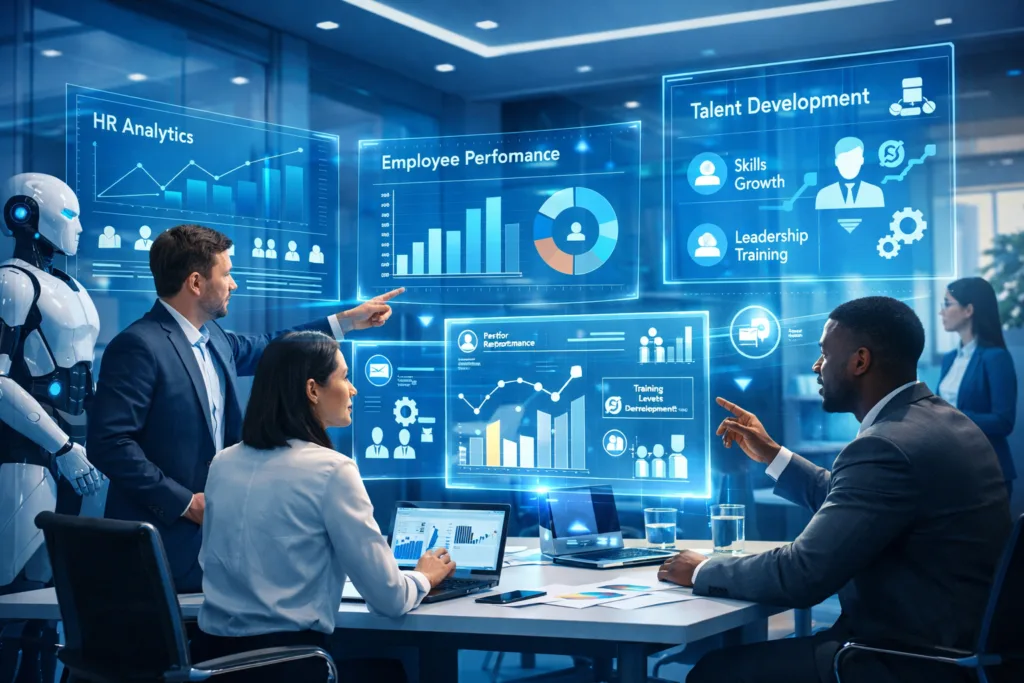
3. Data-Driven HR and Workforce Analytics
HR decisions are increasingly guided by data rather than intuition.
Advanced HR platforms now provide:
Real-time dashboards
Workforce analytics
Turnover and retention insights
Absenteeism and productivity trends
HR analytics enables leadership to make informed decisions about hiring, performance, and workforce optimization.
Why it matters:
Data transforms HR from a support function into a decision-making partner.
4. AI and Machine Learning in HR Operations
Artificial intelligence is reshaping how HR systems operate behind the scenes.
Common AI-powered HR use cases include:
Resume screening and talent matching
Predictive analytics for employee turnover
Chatbots for HR self-service
Performance pattern analysis
AI does not replace HR professionals—it enhances their effectiveness.
Why it matters:
AI increases speed, accuracy, and objectivity in HR processes.
5. Employee Self-Service Platforms
Modern HR systems increasingly empower employees through self-service portals.
Employees can:
Update personal information
Request leave
View payslips
Track attendance
Access policies and documents
This reduces HR workload while improving transparency and employee satisfaction.
Why it matters:
Self-service shifts HR from control-based to experience-based management.
6. Focus on Employee Experience (EX)
HR technology is moving beyond efficiency toward employee experience.
New platforms emphasize:
User-friendly interfaces
Mobile-first design
Personalized dashboards
Seamless workflows
A positive digital experience directly affects engagement, retention, and productivity.
Why it matters:
Organizations compete for talent not only on salary, but on experience.
7. Integrated HR Ecosystems
Standalone HR tools are being replaced by fully integrated HR ecosystems.
Modern systems connect:
HR management
Payroll
Performance management
Learning and development
Compliance and reporting
Integration ensures data consistency and eliminates silos.
Why it matters:
Integrated systems provide a single source of truth for HR data.
8. Compliance-Driven HR Technology
As labor laws and regulations evolve, HR technology increasingly supports compliance.
Modern HR systems help organizations:
Apply labor laws accurately
Track employee records securely
Maintain audit-ready documentation
Reduce legal and regulatory risk
This trend is especially critical for organizations operating across multiple locations.
Why it matters:
Compliance failures are costly—financially and reputationally.
9. Mobile HR Solutions
HR is no longer confined to the office.
Mobile HR applications allow:
Managers to approve requests on the go
Employees to access HR services anytime
Faster communication and response times
Mobile accessibility supports modern, flexible work environments.
Why it matters:
HR must move at the same speed as today’s workforce.
10. Strategic Shift: HR as a Business Partner
Perhaps the most important trend is not technological but strategic.
HR technology is enabling HR departments to:
Align workforce strategy with business goals
Measure human capital impact
Support leadership with real insights
HR is evolving into a core contributor to organizational success.
Why it matters:
Technology empowers HR to lead, not just support.
Challenges Organizations Face When Adopting HR Technology
Despite the benefits, organizations may encounter challenges such as:
Resistance to change
Poor system adoption
Inadequate training
Fragmented legacy systems
Successful implementation requires leadership commitment, clear communication, and proper onboarding.
The Future of HR Technology
Looking ahead, HR technology will continue to evolve toward:
Smarter automation
Deeper analytics
Greater personalization
Stronger integration with business systems
Organizations that embrace these trends early will gain agility, resilience, and a stronger employer brand.
Conclusion
HR technology trends are reshaping how organizations manage people, performance, and potential. Automation, cloud platforms, analytics, AI, and employee-centric design are no longer optional—they define modern HR.
Companies that invest in the right HR technologies today are building the workforce foundations needed to succeed tomorrow.