In a world where technology is no longer a support function but the core engine of business, organizations face a paradox. They depend on increasingly complex IT environments, yet they cannot afford constant disruption, skills shortages, escalating costs, or security blind spots. This is precisely where IT Managed Services emerge not as a luxury, but as a strategic necessity.
IT managed services represent a fundamental shift in how organizations design, operate, secure, and evolve their technology ecosystems. They move IT from a reactive, firefighting role into a predictable, measurable, and growth-enabling service model.
This article provides a deep, authoritative, SEO-optimized exploration of IT managed services: what they are, how they work, why they matter, and how they reshape modern enterprises.
What Are IT Managed Services?
IT Managed Services refer to the outsourcing of ongoing IT operations, responsibilities, and infrastructure management to a specialized third-party provider—commonly known as a Managed Service Provider (MSP).
Unlike traditional IT support models that respond only when problems occur, managed services are:
Proactive, not reactive
Contract-based, not ad hoc
Outcome-driven, not task-based
The MSP assumes responsibility for defined IT functions under a service-level agreement (SLA), ensuring consistent performance, security, availability, and continuous improvement.
At its core, managed services answer a single critical question:
How can an organization run enterprise-grade IT without carrying enterprise-grade complexity internally?
The Evolution of IT Managed Services
From Break-Fix to Strategic Partnership
Historically, IT support followed a break-fix model:
Something fails
A technician is called
The issue is fixed
The cycle repeats
This approach is costly, unpredictable, and fundamentally misaligned with modern digital operations.
Managed services evolved as businesses demanded:
Continuous uptime
Stronger cybersecurity
Faster scalability
Predictable IT spending
Strategic alignment with business goals
Today, managed services function as an extension of the internal IT department, often outperforming in-house teams due to specialization, tooling, and economies of scale.
Core Components of IT Managed Services
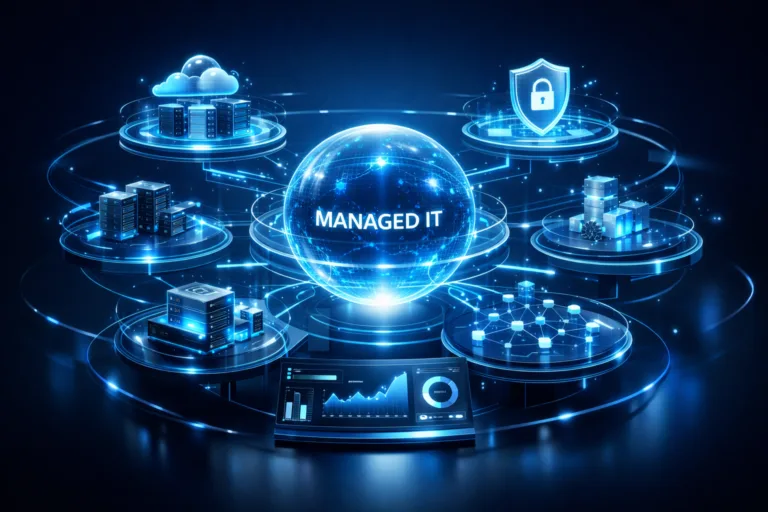
IT managed services are modular by design. Organizations can outsource a single function or their entire IT landscape.
1. Managed Infrastructure Services
This includes the monitoring, maintenance, and optimization of:
Servers (on-premise and virtual)
Storage systems
Data centers
Operating systems
The focus is on availability, performance, and lifecycle management, ensuring infrastructure supports business demands without interruption.
2. Managed Network Services
Network reliability is the foundation of all digital operations.
Managed network services typically cover:
Network design and optimization
24/7 monitoring
Bandwidth management
Firewall and routing configuration
Performance analytics
The objective is simple: secure, fast, and always-available connectivity.
3. Managed Cloud Services
As organizations migrate to the cloud, complexity increases rather than decreases.
Managed cloud services address:
Cloud architecture design
Migration planning and execution
Cost optimization
Performance monitoring
Security and compliance
They ensure cloud environments remain scalable, secure, and financially efficient, rather than becoming uncontrolled cost centers.
4. Managed Cybersecurity Services
Cybersecurity is no longer optional, and it is no longer manageable as a side task.
Managed security services include:
Threat detection and response
Endpoint protection
Vulnerability management
Security patching
Compliance monitoring
Incident response planning
The goal is continuous protection, not periodic audits.
5. Managed Backup and Disaster Recovery
Data loss is not a hypothetical risk it is an inevitability without proper safeguards.
Managed backup services provide:
Automated backups
Secure off-site storage
Disaster recovery planning
Regular recovery testing
This ensures business continuity even in worst-case scenarios.
6. Managed IT Support and Help Desk
End-user productivity directly impacts organizational performance.
Managed support services typically include:
Tiered help desk support
Remote and on-site assistance
Device management
User onboarding and offboarding
Support becomes consistent, documented, and scalable, regardless of company size.
Why Organizations Choose IT Managed Services
1. Cost Predictability and Optimization
Managed services convert IT from a capital-intensive cost into a predictable operating expense.
Benefits include:
Fixed monthly pricing
Reduced emergency spending
Optimized resource utilization
Lower infrastructure overhead
This financial clarity enables better planning and investment decisions.
2. Access to Specialized Expertise
Modern IT spans:
Cloud platforms
Cybersecurity frameworks
Compliance standards
Automation tools
Hiring and retaining experts across all domains internally is unrealistic. Managed services provide instant access to multidisciplinary expertise without long-term staffing risk.
3. Enhanced Security and Compliance
Security breaches are often caused by:
Misconfigurations
Delayed patching
Human error
Lack of monitoring
Managed services reduce these risks through standardized controls, continuous monitoring, and best-practice enforcement.
4. Business Focus and Operational Efficiency
When internal teams are not consumed by:
System outages
Routine maintenance
User support backlogs
They can focus on:
Innovation
Digital transformation
Process optimization
Strategic initiatives
IT becomes an enabler, not a bottleneck.
5. Scalability Without Disruption
Managed services scale up or down as business needs change:
Seasonal demand
Market expansion
Mergers and acquisitions
New digital initiatives
This flexibility is nearly impossible to achieve with fixed internal teams alone.
IT Managed Services vs In-House IT
| Aspect | In-House IT | Managed Services |
|---|---|---|
| Cost Structure | Variable, unpredictable | Fixed, predictable |
| Expertise Coverage | Limited | Broad, specialized |
| Availability | Business hours | 24/7 monitoring |
| Scalability | Slow, resource-heavy | On-demand |
| Security Maturity | Depends on staff | Standardized & proactive |
The decision is not always replacement but augmentation. Many organizations use managed services to strengthen internal teams rather than eliminate them.
Industries That Benefit Most from IT Managed Services
While managed services apply across all sectors, they are particularly impactful in:
Financial services
Healthcare
Education
Retail and e-commerce
Manufacturing
Professional services
SaaS and technology companies
Any industry where uptime, security, and compliance are mission-critical stands to gain immediate value.
Choosing the Right Managed Service Provider
Not all managed service providers deliver the same value. Selection should be based on capability, transparency, and strategic alignment, not price alone.
Key evaluation criteria:
Clear service scope and SLAs
Proven security frameworks
Industry experience
Transparent reporting and KPIs
Scalability and future readiness
Cultural and communication alignment
A strong MSP acts as a long-term technology partner, not a vendor.
Common Myths About IT Managed Services
“Managed services are only for large enterprises”
False. Small and mid-sized organizations often gain the most value due to limited internal resources.
“Outsourcing IT means losing control”
In reality, managed services increase visibility through dashboards, reports, and documented processes.
“Managed services are expensive”
Unmanaged downtime, breaches, and inefficiencies are far more costly than predictable service fees.
The Future of IT Managed Services
The managed services model continues to evolve toward:
AI-driven monitoring
Predictive maintenance
Automated remediation
Deeper business integration
Outcome-based pricing models
Managed services are shifting from IT management to digital operations management, aligning technology performance directly with business outcomes.
Frequently Asked Questions (FAQ)
What is the difference between IT support and IT managed services?
IT support is reactive and task-based. Managed services are proactive, continuous, and outcome-driven.
Are IT managed services secure?
When delivered by a reputable provider, managed services significantly improve security posture through continuous monitoring and best practices.
Can managed services work with existing IT teams?
Yes. Many organizations use managed services to augment internal capabilities, not replace them.
Do managed services lock businesses into long contracts?
Modern providers offer flexible agreements aligned with business growth and evolving needs.
Final Thoughts
IT managed services are no longer a tactical outsourcing decision they are a strategic operating model.
They bring structure to complexity, predictability to cost, resilience to infrastructure, and clarity to IT operations. In an era where technology defines competitiveness, managed services enable organizations to move faster, operate safer, and think bigger.
The organizations that thrive tomorrow will not be those that own the most technology but those that manage it best.