Introduction
For years, businesses relied on large, monolithic software systems to manage accounting, operations, HR, inventory, and reporting. These systems promised “everything in one place,” yet many organizations discovered a hidden cost: rigidity.
As markets evolve faster and businesses grow more complex, a new model has emerged Modular Business Software Platforms. Instead of forcing companies to adapt to software, modular platforms adapt to the company.
This architectural shift is redefining how modern organizations build, scale, and control their digital operations.
What Are Modular Business Software Platforms?
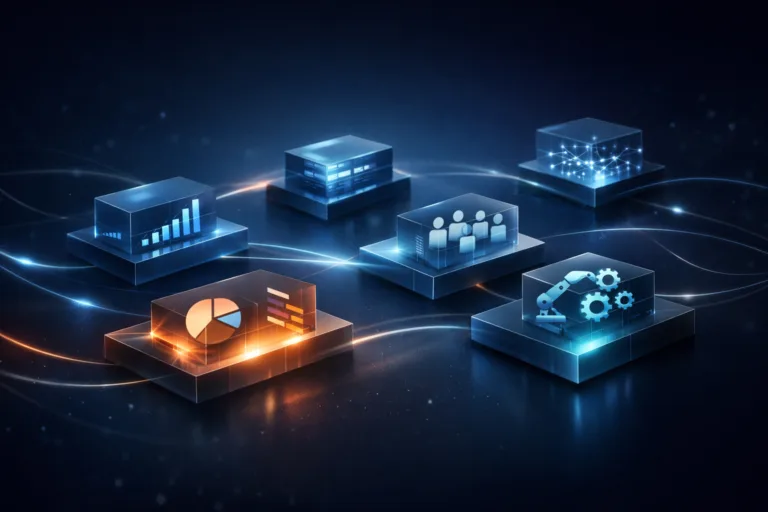
A modular business software platform is a system built from independent but connected modules, each responsible for a specific business function such as finance, HR, operations, sales, inventory, or analytics.
Each module:
Can operate independently
Integrates seamlessly with other modules
Can be added, removed, or upgraded without affecting the entire system
This is fundamentally different from traditional all-in-one systems, where a single change can impact the entire platform.
Why Traditional Systems Are No Longer Enough
Traditional ERP systems were designed for a slower era. Today’s businesses face challenges such as:
Rapid growth
Regulatory changes
Multi-branch operations
Cross-border transactions
Continuous process optimization
Monolithic systems struggle because they:
Require full upgrades for small changes
Lock companies into rigid workflows
Increase implementation and maintenance costs
Limit scalability and customization
Modular platforms solve these problems at the architectural level.
The Core Advantages of Modular Business Software Platforms
1. True Scalability
Companies rarely need every function on day one. Modular platforms allow organizations to start with essential modules and expand gradually as needs evolve.
This prevents:
Over-investment
Unused features
Complex implementations
Growth becomes intentional, not forced.
2. Flexibility Without Chaos
Unlike disconnected tools, modular platforms maintain centralized data and governance while allowing functional flexibility.
This means:
Finance can evolve independently from HR
Operations can scale without disrupting accounting
New business units can be added smoothly
3. Lower Long-Term Cost
While traditional systems may appear cheaper initially, their long-term costs are often higher due to:
Forced upgrades
Customization limitations
Vendor lock-in
Modular platforms reduce these risks by enabling selective investment and incremental upgrades.
4. Faster Innovation Cycles
Because modules are independent, innovation becomes continuous rather than disruptive.
Businesses can:
Adopt new features faster
Respond to regulatory or market changes quickly
Experiment without system-wide risk
Modular Platforms vs Traditional ERP
| Aspect | Traditional ERP | Modular Platforms |
|---|---|---|
| Architecture | Monolithic | Component-based |
| Scalability | Limited | High |
| Customization | Risky | Controlled |
| Upgrade Impact | System-wide | Module-specific |
| Business Agility | Low | High |
Who Should Use Modular Business Software Platforms?
Modular platforms are especially valuable for:
Growing SMEs
Multi-branch companies
Organizations planning regional expansion
Businesses undergoing digital transformation
Companies with evolving regulatory requirements
They are not about replacing structure — they are about designing smarter structure.
The Strategic Shift: From Software Ownership to Software Architecture
The real value of modular platforms is not technology — it is control.
Control over:
Business processes
Data flows
Growth strategy
Future decisions
Instead of asking, “Does the system support this?” companies ask,
“Which module do we need next?”
This shift represents maturity in digital thinking.
How Modular Platforms Support Long-Term Digital Transformation
Digital transformation is not a one-time project. It is a continuous journey.
Modular platforms support this by:
Allowing gradual transformation
Reducing operational risk
Aligning IT with business strategy
Supporting both cloud and hybrid models
They turn transformation from a disruption into a managed evolution.
Final Thoughts
Modular Business Software Platforms are not a trend they are an architectural response to modern business reality.
As complexity increases and agility becomes a competitive advantage, companies that invest in modular platforms position themselves for sustainable growth, operational clarity, and long-term control.
The future belongs to systems that grow with the business not systems that the business must grow around.