Introduction: The Rise of Intelligent Operations
In an era defined by rapid technological change, shifting customer demands, and fierce competition, organizations can no longer rely on traditional operational models. Efficiency alone is no longer enough — companies must adopt intelligent, data-driven systems that can sense, analyze, and respond to operational challenges in real time.
This shift has given rise to one of the most transformative concepts in digital business architecture: the Strategic Digital Operations System.
More than a tool, this system serves as the central command center for the modern enterprise integrating processes, automating workflows, and enabling leaders to make strategic decisions with clarity and confidence.
What Is a Strategic Digital Operations System?
A Strategic Digital Operations System (SDOS) is a unified digital platform that:
Digitizes and streamlines operational processes
Integrates departmental systems into one intelligent hub
Continuously monitors business performance
Uses analytics and AI to support decision-making
Enhances operational visibility across the organization
It acts as the digital brain of the company connecting people, processes, data, and technology.
Core Components of a Strategic Digital Operations System
1. Digital Command Center
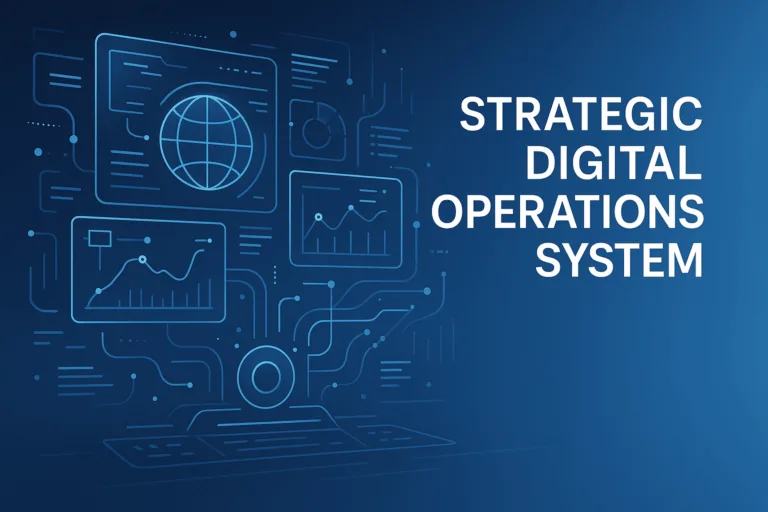
SDOS brings all operational and performance data into a single, real-time dashboard.
This includes:
Sales
Inventory
Finance
Production
Human resources
Customer service
Supply chain
Leaders gain a holistic view of the organization at any moment.
2. Process Automation
Manual tasks slow teams down and create inconsistencies.
SDOS automates:
Approvals
Workflows
Daily operations
Notifications
Task assignments
This reduces errors and improves operational throughput.
3. Operational Analytics
Using advanced analytics, the system provides:
Real-time KPIs
Trend analysis
Variance tracking
Performance scoring
Root-cause insights
It empowers managers to identify issues early and make data-backed improvements.
4. AI-Driven Decision Support
Artificial intelligence enhances decision-making by evaluating patterns and offering recommendations on:
Resource allocation
Risk detection
Process optimization
Workforce planning
Production forecasting
This transforms the organization into a proactive, not reactive, enterprise.
5. System Integration
SDOS integrates seamlessly with:
ERP
CRM
HRMS
Financial platforms
POS systems
Inventory and warehouse systems
This creates a unified data ecosystem that eliminates silos and ensures consistency.
Benefits of a Strategic Digital Operations System
⭐ 1. Unmatched Operational Efficiency
Automation and intelligent workflows increase output without increasing effort.
⭐ 2. Faster, Smarter Decision-Making
Leaders gain instant access to accurate, real-time data.
⭐ 3. Reduced Operational Costs
Lower manual workload, fewer errors, and optimized processes drive cost savings.
⭐ 4. Scalability and Business Growth
The system grows with the organization — supporting more users, more data, and new business models.
⭐ 5. Enhanced Customer Experience
Faster processes and unified operations result in better service delivery.
⭐ 6. Full Transparency and Accountability
With all activities and KPIs tracked, every team knows their impact and performance.
Industries That Benefit Most from SDOS
Retail & distribution
Manufacturing & industrial sectors
Real estate and property management
Education and training
Healthcare institutions
Financial services
Government and public-sector entities
Professional services
Any organization with multi-step, multi-department operations can dramatically improve performance through SDOS.
How SDOS Transforms the Future of Operations
✔ Shifts organizations from manual to intelligent workflows
✔ Unlocks real-time operational visibility
✔ Drives consistent improvement through analytics
✔ Improves responsiveness to market changes
✔ Supports AI-driven strategy and automation
SDOS is not merely an upgrade it is the foundation of modern digital transformation.
Future Trends in Strategic Digital Operations Systems
The next generation of SDOS will include:
Deeper AI-based automation
Voice-powered dashboards
Predictive risk modeling
Self-service analytics for all employees
Mobile-first command centers
Digital twins for operational simulations
Hyper-automation across all business units
These innovations will shape how organizations operate in the next decade.
Conclusion
A Strategic Digital Operations System provides a powerful competitive advantage for organizations aiming to thrive in the digital era.
By integrating operations, automating processes, and enabling data-driven decision-making, SDOS becomes the operational backbone of a modern enterprise.
Companies that adopt it today will lead the market tomorrow with greater agility, transparency, and strategic intelligence.