
Introduction
In today’s hyper-competitive business environment, organizations are no longer judged solely by their products or services, but by how efficiently they operate. Every wasted process, redundant task, or delayed decision translates directly into lost revenue and missed opportunities.
This is where Operational Efficiency Software emerges not as a luxury, but as a necessity.
Operational efficiency is no longer about working harder; it is about working smarter, faster, and more intelligently. Businesses that embrace this philosophy gain a decisive competitive edge, while those that ignore it fall behind.
What is Operational Efficiency Software?
Operational Efficiency Software refers to a suite of digital tools and systems designed to:
- Streamline business processes
- Automate repetitive tasks
- Optimize resource utilization
- Improve decision-making through real-time data
At its core, it transforms fragmented operations into a cohesive, intelligent system.
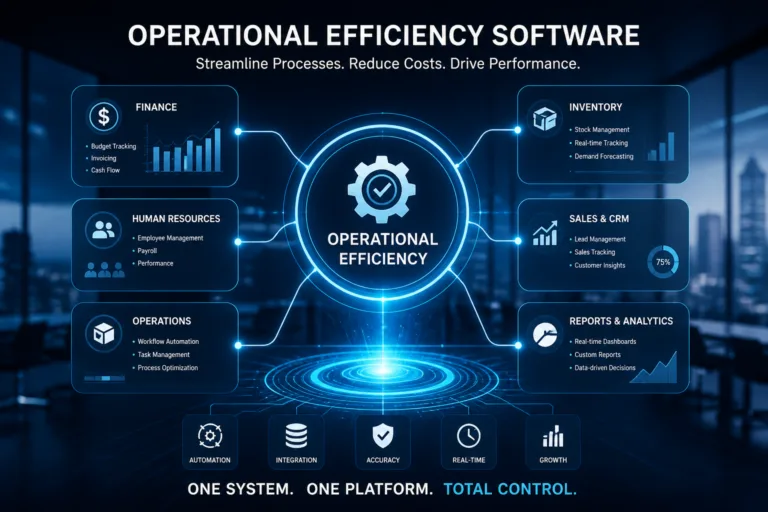
Unlike traditional systems that operate in silos, operational efficiency software connects departments such as:
- Finance
- Human Resources
- Operations
- Sales
- Inventory
into one unified ecosystem.
Why Operational Efficiency Matters More Than Ever
Modern businesses face increasing pressure from:
- Rising operational costs
- Complex regulatory environments
- Customer expectations for speed and accuracy
- Rapid digital transformation
Without efficiency, these pressures become overwhelming.
The Cost of Inefficiency
Inefficiency manifests in multiple forms:
- Manual data entry errors
- Delayed reporting
- Poor communication between departments
- Redundant processes
- Lack of real-time insights
These issues compound over time, creating hidden costs that quietly erode profitability.
Core Features of Operational Efficiency Software
To truly deliver value, operational efficiency software must include the following capabilities:
1. Process Automation
Automation eliminates repetitive manual tasks such as:
- Data entry
- Invoice processing
- Payroll calculations
- Workflow approvals
This reduces human error and frees employees to focus on strategic work.
2. Centralized Data Management
A single source of truth ensures:
- Accurate reporting
- Consistent data across departments
- Faster decision-making
Instead of searching across systems, decision-makers access everything in one place.
3. Real-Time Analytics and Reporting
Modern businesses cannot rely on outdated reports.
Operational efficiency software provides:
- Real-time dashboards
- Performance metrics
- Predictive insights
This enables proactive decision-making rather than reactive responses.
4. Workflow Optimization
By mapping and optimizing workflows, businesses can:
- Identify bottlenecks
- Reduce process delays
- Improve coordination between teams
5. Integration Capabilities
Efficiency depends on connectivity.
The software must integrate with:
- Accounting systems
- CRM platforms
- HR systems
- E-invoicing platforms
This eliminates duplication and ensures seamless operations.
Key Benefits of Operational Efficiency Software
1. Reduced Operational Costs
Automation and optimization directly lower costs by:
- Minimizing manual labor
- Reducing errors
- Eliminating redundant processes
2. Increased Productivity
Employees spend less time on routine tasks and more on:
- Strategy
- Innovation
- Customer engagement
3. Faster Decision-Making
With real-time data, leaders can:
- Respond instantly to market changes
- Identify opportunities early
- Mitigate risks effectively
4. Improved Accuracy
Automation ensures:
- Fewer human errors
- More reliable financial data
- Better compliance with regulations
5. Enhanced Customer Experience
Efficient operations lead to:
- Faster service delivery
- Accurate order processing
- Improved responsiveness
Operational Efficiency Software vs Traditional ERP
Many businesses confuse operational efficiency software with ERP systems.
The Difference:
| Aspect | Traditional ERP | Operational Efficiency Software |
|---|---|---|
| Focus | Data management | Process optimization |
| Approach | Record-keeping | Intelligent automation |
| Speed | Often slower | Real-time performance |
| Flexibility | Limited | Highly adaptable |
Modern solutions combine both capabilities, delivering ERP functionality enhanced with efficiency-driven intelligence.
Use Cases Across Industries
1. Financial Management
- Automating accounting processes
- Managing cash flow efficiently
- Generating real-time financial reports
2. Human Resources
- Streamlining recruitment
- Automating payroll
- Managing employee performance
3. Operations and Inventory
- Optimizing stock levels
- Reducing waste
- Improving supply chain visibility
4. Sales and Customer Management
- Tracking leads and conversions
- Automating follow-ups
- Enhancing customer insights
The Role of AI in Operational Efficiency
Artificial Intelligence is transforming operational efficiency software by enabling:
- Predictive analytics
- Intelligent automation
- Smart recommendations
- Pattern recognition
AI shifts operations from reactive to predictive and proactive systems.
Challenges Without Operational Efficiency Software
Organizations that rely on outdated systems often face:
- Fragmented data
- Inefficient workflows
- High operational costs
- Poor scalability
Over time, these challenges limit growth and competitiveness.
How to Choose the Right Operational Efficiency Software
Selecting the right solution requires careful evaluation:
1. Scalability
The system should grow with your business.
2. Customization
It must adapt to your workflows—not the other way around.
3. Integration
Seamless connectivity with existing systems is critical.
4. User Experience
A complex system reduces adoption and efficiency.
5. Local Compliance
Especially important in markets like Jordan with evolving regulations.
Operational Efficiency in Jordan: A Growing Necessity
In Jordan, businesses are increasingly adopting digital solutions due to:
- Government-driven digital transformation
- E-invoicing requirements
- Competitive market conditions
Operational efficiency software is becoming a key driver of:
- Business sustainability
- Compliance
- Growth
Future of Operational Efficiency Software
The future will be defined by:
- AI-driven automation
- Cloud-based systems
- Real-time decision intelligence
- Fully integrated ecosystems
Organizations that adopt these technologies early will lead their industries.
Conclusion
Operational Efficiency Software is no longer optional—it is foundational.
It transforms businesses from:
- Reactive → Proactive
- Fragmented → Integrated
- Inefficient → Optimized
In a world where speed, accuracy, and adaptability define success, operational efficiency is the ultimate competitive advantage.