
Introduction: A Region on the Edge of a Technological Leap
Over the past decade, the Middle East has undergone one of the fastest digital transformations globally. Governments across the region—particularly in the GCC and Levant—are pushing forward with national digitization programs, smart governance, and cloud-first strategies.
Parallel to this shift, businesses have realized that traditional, on-premise software can no longer sustain the speed and complexity of modern operations.
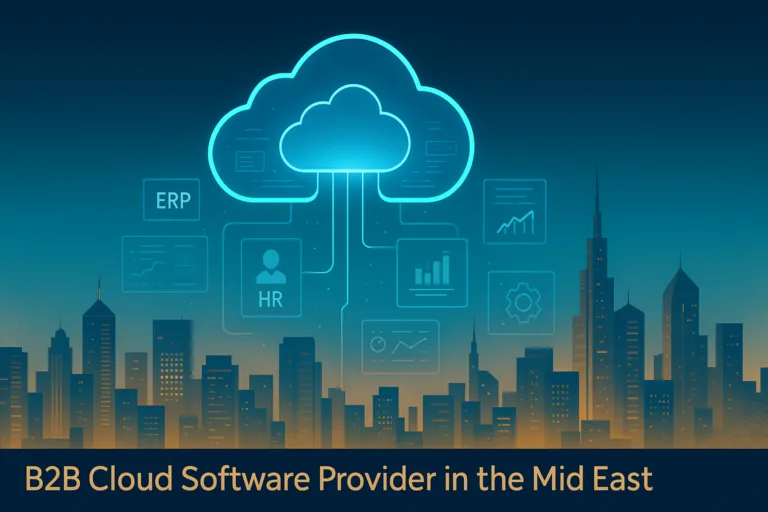
This evolution has created growing demand for B2B cloud software providers, who now play a critical role in enabling organizations to operate efficiently, securely, and competitively. From SMEs to large enterprises, companies increasingly rely on cloud-based ERP, HR, financial management, education platforms, and property management systems that are localized to Middle Eastern regulations and workflows.
What Does a B2B Cloud Software Provider Do?
A B2B cloud software provider delivers business systems and applications over the cloud rather than requiring physical servers or local installations.
Their role goes far beyond simple software delivery. They provide:
1. Cloud Infrastructure & Hosting
Secure environments to host applications, databases, and sensitive business information—with guaranteed uptime and disaster recovery.
2. SaaS Business Applications
End-to-end platforms covering:
Accounting & financial management
Human resources & payroll
School and education systems
Real estate and property management
Inventory, distribution, sales force automation
Business intelligence and KPI monitoring
3. Security, Compliance, and Data Protection
Middle Eastern businesses—especially those subject to local tax and labor laws—need systems compliant with:
Saudi ZATCA regulations
Jordanian labor law & tax compliance
UAE data protection policies
GCC VAT frameworks
A specialized B2B cloud provider ensures that software remains legally compliant and up to date.
4. Integration and API Ecosystems
Modern cloud platforms connect seamlessly with:
E-invoicing platforms
Banking APIs
Payment gateways
Government portals
BI dashboards
CRM and e-commerce systems
This integration capability is a core value of a strong cloud provider.
Why Cloud Software Is Transforming Middle Eastern Businesses
1. Speed of Deployment
Businesses no longer wait weeks to install servers or configure complex infrastructure. Cloud systems can be deployed instantly, giving companies a faster path to digital readiness.
2. Cost Efficiency
Cloud eliminates large capital expenses and replaces them with predictable monthly subscriptions—an advantage especially for SMEs in Jordan, Saudi Arabia, Egypt, and the UAE.
3. Scalability for Regional Growth
As companies expand into multiple branches or countries, cloud systems allow them to scale seamlessly without re-engineering their IT stack.
4. Access from Anywhere
Remote work, multi-branch operations, mobile sales teams, and distributed education networks rely on cloud access to stay connected.
5. Built-in Compliance & Localization
Middle Eastern markets have unique administrative, legal, linguistic, and financial requirements.
Cloud providers specializing in the region can deliver:
Arabic/English bilingual interfaces
VAT automation
Payroll calculations aligned with local laws
Local financial reporting formats
This is a major differentiator from global software providers.
Key Industries Benefiting from Cloud Software in the Middle East
1. Financial Services and Accounting Firms
They require precise, compliant, multi-currency systems with automated reporting—especially in countries with strict tax frameworks.
2. Education Sector
Cloud-based education platforms now support admissions, student information systems, payments, HR, finance, and e-learning—greatly simplifying school operations.
3. Real Estate & Property Management
Commercial and residential rental markets depend on automated billing, contract management, and portfolio tracking.
4. Distribution, FMCG, and Field Sales
Mobile van sales and sales force automation tools empower teams to work offline, sync data instantly, and reduce errors in invoicing and inventory.
5. SMEs Across All Industries
Cloud software finally levels the playing field, giving smaller companies access to advanced tools previously available only to major enterprises.
Critical Capabilities of a Leading B2B Cloud Software Provider
A true regional provider must excel in several areas:
1. End-to-End Product Ecosystem
All systems—ERP, HR, finance, education, CRM, operations—must work together seamlessly under one platform.
2. Local Regulatory Understanding
The Middle East has different tax, payroll, and compliance rules. Providers must update software automatically as laws change.
3. Secure Cloud Infrastructure
With increasing cybersecurity risks, solutions must include:
Data encryption
Multi-layer authentication
Managed backup
Disaster recovery plans
ISO-standard hosting environments
4. High Localization Quality
Arabic support, regional date formats, local currencies, and cultural UX expectations are mandatory.
5. Strong Customer Support & Training
Cloud adoption succeeds when providers offer onboarding, consultation, and ongoing technical support tailored to the local business environment.
How B2B Cloud Providers are Shaping the Future of the Region
1. Enabling Digital-First Economies
Countries like Saudi Arabia, UAE, and Jordan are promoting cloud-first strategies, making modern cloud software essential for private sector competitiveness.
2. Accelerating SME Digitization
Cloud solutions lower the barrier to adopting business technology—helping SMEs modernize faster.
3. Creating Unified Business Ecosystems
Instead of scattered apps, companies are moving toward integrated cloud platforms that manage every process in one place.
4. Powering Data-Driven Decision Making
With real-time dashboards, KPIs, analytics, and BI, businesses gain deep insight into performance and can make informed decisions instantly.
5. Increasing Regional Competitiveness
A well-developed cloud ecosystem helps Middle Eastern businesses enter new markets and compete internationally.
Challenges Facing B2B Cloud Software Providers in the Middle East
Despite massive growth, challenges remain:
1. Data Localization Laws
Some countries require data to be hosted within their borders. Providers must offer flexible cloud hosting options.
2. Industry-Specific Customization
Companies often need custom workflows aligned with local business culture.
3. Integration with Legacy Systems
Many organizations still use outdated on-premise software.
4. Market Education
SMEs sometimes lack awareness of cloud benefits or fear moving away from traditional systems.
A successful provider must address these barriers with strong technology and customer-centered services.
Looking Ahead: The Future of B2B Cloud Software in the Middle East
The next decade will witness:
✔ AI-driven automation for finance, HR, and operations
✔ Predictive analytics and real-time BI
✔ Integrated e-invoicing and regulatory automation
✔ More regional SaaS platforms replacing global generic solutions
✔ Expansion of cloud-native mobile ecosystems for operations and field teams
As regional economies continue to push digital transformation agendas, B2B cloud providers will become the infrastructure powering the next era of business modernization in the Middle East.
Conclusion
B2B cloud software providers today are not just technology vendors they are strategic partners enabling growth, compliance, scalability, and digital maturity.
In a region as diverse and fast-moving as the Middle East, businesses need localized, secure, integrated cloud solutions capable of supporting complex operations and rapidly evolving regulatory environments.
With the right provider, companies can unlock efficiency, reduce operational costs, improve decision-making, and build a sustainable digital foundation for the future.